Working in Italy: the complete guide for French speakers
Italy attracts thousands of French speakers every year who are looking to start a new professional life. Job market, salaries, thriving sectors, administrative procedures: discover everything you need to know to make your work project in Italy a success.

Working in Italy: what you need to know before you go
Italy is the third-largest economy in the eurozone. Between its dynamic major cities such as Milan, Rome and Turin, and its fast-growing regions, the Italian job market offers real opportunities for well-prepared international candidates. Whether you are looking for a job in Italy in tech, tourism, healthcare or engineering, this guide gives you all the keys to succeed.
Visa and work permits: who can work in Italy?
As a citizen of the European Union, you can work in Italy without a visa or work permit. The free movement of persons guaranteed by European treaties allows you to enter, reside and carry out professional activities in Italy just as you would in your home country.
However, nationals of third countries (outside the EU/EEA) must obtain a work permit (permesso di soggiorno per lavoro) before taking up employment. The process goes through the decreto flussi, an annual quota set by the Italian government for the entry of non-European workers.
Key point: Even if you do not need a visa, two steps are essential upon arrival: obtaining your codice fiscale (Italian tax identification number, required for any employment contract, housing or bank account) and registering with the municipal office (comune) of your place of residence if you plan to stay for more than 3 months.
The Italian job market: understanding how it works
The Italian economy is dominated by SMEs (small and medium-sized enterprises), which account for more than 90% of the country's businesses. These absorb the vast majority of job openings, across sectors as varied as food and agriculture, textiles, mechanical engineering, design and tourism.
The sectors with the highest recruitment in 2026 are:
- Information technology (IT) and digital: developers, data scientists and cybersecurity experts are in high demand, particularly in Milan.
- Engineering and industry: northern Italy (Lombardy, Piedmont, Emilia-Romagna) is home to numerous industrial and manufacturing companies.
- Tourism and hospitality: with more than 65 million tourists per year, Italy has a constant need for qualified staff, and French is often an asset.
- Healthcare and personal services: the ageing of the Italian population is creating strong demand for doctors, nurses and care assistants.
- Finance and business services: Milan is the country's primary financial centre, with many opportunities for qualified profiles.
Salaries in Italy: what to expect?
The average salary in Italy is approximately €2,582 gross per month, but this average conceals very significant regional and sectoral disparities. The north of the country (Milan, Turin, Bologna) offers considerably higher remuneration than the south. In the IT sector, an experienced developer can expect €40,000–60,000 gross annually in Milan, while tourism and catering tends to remain below an annual average of €20,000.
Italy does not have a single statutory minimum wage (salario minimo) as found in some other countries. Minimum wage floors are set sector by sector through national collective agreements (contratti collettivi nazionali di lavoro, CCNL), negotiated between trade unions and employer organisations. It is therefore essential to research the CCNL applicable to your sector before accepting an offer.
For more information, consult our detailed guide on salaries in Italy.
How to look for a job in Italy from abroad?
Looking for work in Italy from abroad requires a multi-channel approach. Here are the main resources to use:
1. Online job platforms
Several websites allow you to search for a job in Italy directly online:
- LinkedIn: essential for qualified profiles and major Italian companies. Remember to indicate your availability to relocate to Italy in your profile.
- Indeed Italy (it.indeed.com): the most widely used job search engine in Italy.
- InfoJobs, Monster.it, Subito.it: very popular platforms among Italian companies, particularly for local positions.
- Welcome to the Jungle: features listings from European companies recruiting in Italy, with detailed company profiles.
- Meteojob and Jooble: aggregators listing thousands of job offers in Italy.
2. The Italian public employment service
Once in Italy, the Centri per l'impiego (CPI) are the Italian equivalent of public employment services. By registering with them, you can access local job offers, personalised support and training. The national portal Cliclavoro (cliclavoro.gov.it) centralises job listings across the entire country and provides information on workers' rights, contract types and available assistance. Access to certain online services requires a SPID, the Italian digital identity credential.
3. Recruitment agencies
Major international staffing and recruitment agencies are well established in Italy: Adecco, Manpower, Randstad and their Italian counterparts offer temporary assignments, permanent contracts and specialist placements. Italy has approximately 700 private agencies accredited by the Ministry of Labour. This is an excellent entry point for profiles who want to explore the market before committing long-term.
4. The French Chamber of Commerce and Industry in Italy
For French-speaking candidates, the French Chamber of Commerce and Industry in Italy is a valuable resource. Its portal job-chambre.it publishes job offers specifically targeted at bilingual or French-speaking profiles, particularly in major Italian cities. It is also an excellent network for meeting French companies established in Italy.
5. The VIE (International Business Volunteer Programme)
If you are between 18 and 28 years old, the Volontariat International en Entreprise (VIE), managed by Business France, is an ideal scheme for a first professional experience in Italy. You are seconded to a French company abroad for a period of 6 to 24 months, with a secure status and a net remuneration exempt from income tax.
6. Networking
In Italy, word of mouth (passaparola) remains one of the most effective channels for finding a job. Join expatriate communities (Facebook groups, forums, associations), attend professional events and do not hesitate to reach out directly to professionals in your sector via LinkedIn.
Language: a central issue for working in Italy
The language question is often the first concern for those wishing to work in Italy. The reality is nuanced: Italian is virtually essential for the vast majority of jobs, particularly in SMEs, public administration, healthcare, education and local commerce.
However, some work environments operate primarily in English or explicitly value French: multinationals, French-speaking call centres, luxury tourism companies and certain roles in major cities. On Italian job platforms, search for the keywords « francese », « madrelingua francese » or « French speaker » to identify these opportunities.
Investing in learning Italian before your departure always pays off: a B1/B2 level is sufficient for most positions and will make a very strong impression during your job interviews.
Adapting your CV to the Italian market
The Italian-style CV (curriculum vitae) differs from other models on several points. It is generally more concise (1 page for junior profiles, 2 pages maximum for experienced candidates), written in Italian and structured according to the Europass format or a similar layout. A photo is usually included. The cover letter (lettera di presentazione) is less systematic than in some countries but is appreciated for qualified positions.
Make sure to follow the application instructions specified in each job posting: online application via the company's website (under the « Lavora con noi » section), submission by e-mail, or via job platforms.
Les villes où travailler en Italie
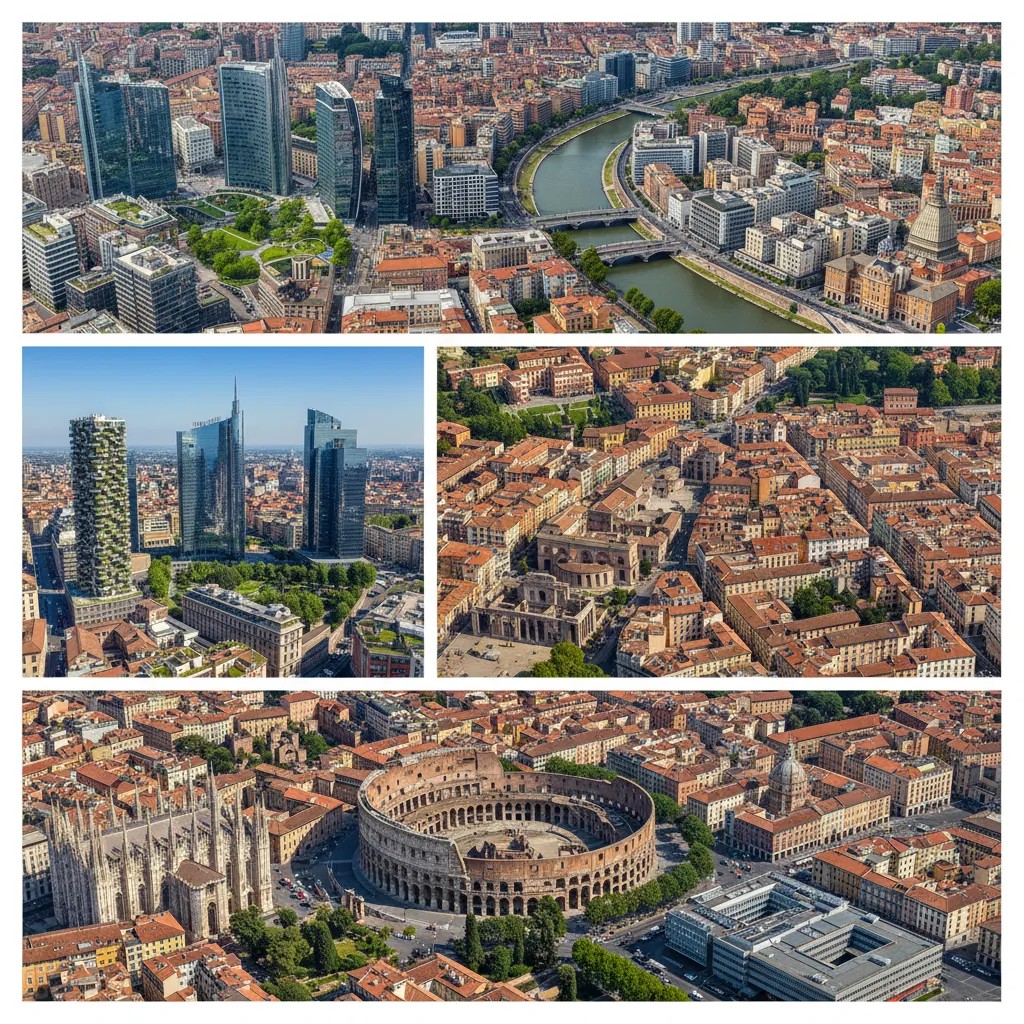
The choice of city is a decisive factor in your professional project in Italy. Each major metropolis has its own economic profile, cost of living, and specific opportunities. From Milan's financial dynamism to Rome's administrative richness, through Turin's industrial heritage, here is an overview of the main destinations for French-speaking professionals.
Milan : the economic capital of Italy. Finance, fashion, design, tech and startups: Milan concentrates the highest salaries and the most numerous opportunities for qualified profiles.
Rome : the administrative capital. European institutions, embassies, tourism, media and public services offer many career openings, particularly for legal, diplomatic and linguistic profiles.
Turin : the cradle of Italian industry. Stellantis (formerly Fiat), aerospace, engineering and an emerging startup scene make Turin an ideal city for engineers and technical profiles.
Bologna and Verona : two dynamic economic hubs in the north, with active job markets in logistics, agri-food and services.
Why work in Italy in 2026?
Italy offers much more than just a job. Here are the advantages that attract French speakers every year.
Exceptional quality of life
Mild climate, gastronomy, cultural heritage and a balanced pace of life: Italy consistently ranks among the countries with the best art of living in Europe.
No visa required for Europeans
As a French or European citizen, you can work in Italy freely without any visa formalities. Only the codice fiscale is required.
Fast-growing sectors
IT, engineering, healthcare, tourism: sectors that are actively recruiting and offering career prospects for qualified profiles.
Attractive tax benefits
The flat tax and the impatriates regime offer significant tax advantages for new tax residents in Italy.
Moderate cost of living
Outside Milan, the cost of living in Italy remains lower than in Paris. Housing, food and transport are often cheaper in mid-sized cities.
Active French-speaking community
Several Italian cities are home to vibrant French-speaking communities, expatriate associations and French companies.
Practical guide: steps to find a job in Italy
Organising your job search in Italy effectively requires a structured approach. Here are the key steps to follow to maximise your chances of success.
Learn Italian
A minimum level of B1/B2 is recommended. Enrol in online courses (Duolingo, Babbel, Alliance Française courses) several months before your departure.
Prepare your CV in Italian
Adapt your CV to the Europass format or Italian standard: concise, with a photo, written in Italian. Have it reviewed by a native speaker if possible.
Activate your networks
Join LinkedIn and Facebook groups for expatriates in Italy. Contact the French Chamber of Commerce (job-chambre.it) and Business France.
Apply widely
Use LinkedIn, Indeed Italy, InfoJobs, Monster.it, Welcome to the Jungle and Jooble. Also apply speculatively via the "Lavora con noi" sections of your target companies.
Obtain your codice fiscale
Essential for any employment contract, apartment rental or bank account opening. Apply at the Revenue Agency (Agenzia delle Entrate) or at your country's consulate in Italy.
Register at the Centro per l'impiego
Once you have arrived, register with the local public employment service (Centro per l'impiego) to access regional job listings and free support in your job search.
Working in Italy as a self-employed person or entrepreneur
Italy also offers interesting opportunities for those who wish to set up on their own. The partita IVA status (VAT number / equivalent of a sole trader registration number) allows you to carry out independent professional activities. The flat-rate scheme (regime forfettario) is particularly advantageous for self-employed individuals: a reduced tax rate of 15% (5% for the first 5 years under certain conditions) applies to income, up to a ceiling of €85,000 in annual turnover.
For entrepreneur or freelance profiles, our team offers a specialist support service to help you structure your relocation to Italy under the best possible tax and administrative conditions.
Taxation for workers in Italy: key advantages to know
Italy has introduced several attractive tax regimes to draw in skilled foreign workers:
- Inpatriate regime (regime impatriati): workers who transfer their tax residence to Italy may benefit from a 50% exemption (70% in southern Italy) on their employment income for 5 years, subject to conditions.
- Flat tax for retirees: foreign retirees who settle in a municipality of fewer than 20,000 inhabitants in southern Italy benefit from a flat tax rate of 7% on their foreign income for 10 years.
- Flat-rate scheme for the self-employed: tax rate of 15% (5% for the first 5 years) up to €85,000 in annual turnover.
To find out more about taxation, consult our comprehensive guide on taxation in Italy or discover the Italian flat tax regime.
Employment in Italy
Your questions about working in Italy
Find answers to the most frequently asked questions from French speakers who wish to work in Italy.

Need personalised support?
Aller en Italie is a French-speaking company based in Italy that supports French speakers in all their life projects in Italy: employment, business creation, relocation, real estate and taxation.
Our French-speaking experts help you identify the best opportunities based on your profile, understand the local job market and complete all the necessary administrative procedures.
From the first orientation meeting to your first day on the job, we support you at every step to ensure your work in Italy project comes to fruition in the best possible conditions.
Whether you are an employee, self-employed, or an entrepreneur, we have a support programme tailored to your situation.
Guides by city
Each Italian city has its own characteristics. Explore our detailed guides for the main work destinations.
Working in Milan
Italy's economic capital: finance, tech, fashion and start-ups. The highest salaries and the most numerous opportunities.
Working in Rome
The Italian capital offers many opportunities in administration, tourism, media and European institutions.
Working in Turin
Italy's industrial heartland, Turin attracts engineers and technical profiles. The automotive and aerospace industries have a strong presence there.
Working in Bologna
A logistical and academic hub in northern Italy, Bologna offers a diverse job market and a high quality of life.
Working in Verona
A border city with Germany and Austria, Verona is a logistics and commercial hub with many bilingual opportunities.
Salaries in Italy
Everything you need to know about salaries by sector and region in Italy. Compare your future salary and understand collective bargaining agreements.
Ready to make your work project in Italy a reality?
Our French-speaking experts based in Italy will guide you through every step. Book an appointment for a free orientation consultation.